How McKinsey, BCG, and Bain Actually Score Your Case Interview
- Kashish Malhotra

- 3 days ago
- 9 min read
You've spent months drilling frameworks. You can calculate market sizes in your sleep. You've memorized every profitability tree variation known to humankind.
And yet, something feels off.
Because deep down, you suspect that acing your McKinsey, BCG, or Bain case interview requires something more than just knowing the difference between a 3C and a 4P framework.
You're right.
Here's the uncomfortable truth: consulting firms aren't hiring calculators. They're hiring future advisors, team leaders, and problem solvers who can handle the messy, unpredictable reality of consulting work. And their interview scorecards reflect exactly that.
After years of coaching candidates through interviews and speaking with interviewers on the other side of the table, I can tell you this: what gets measured in your case interview has very little to do with what most candidates obsess over.
Let me show you what's really on that scorecard and, more importantly, how to nail each dimension.
What This Article Covers
In this guide, you'll discover:
The three real evaluation criteria that MBB interviewers use (and why frameworks barely matter)
Why "strategic thinking" is actually about knowing when NOT to use your favorite framework
The subtle communication shifts that separate good candidates from great ones
How to handle curveballs without panicking (even when your entire approach needs to change)
Practical examples and specific language patterns that signal executive presence
The biggest misconception candidates have about case interviews (and how to avoid it)
MBB Case Interview Scorecard: What's Actually Being Measured
When your interviewer pulls up that evaluation form after your case interview, they're not checking boxes for "recited framework correctly" or "did mental math fast."
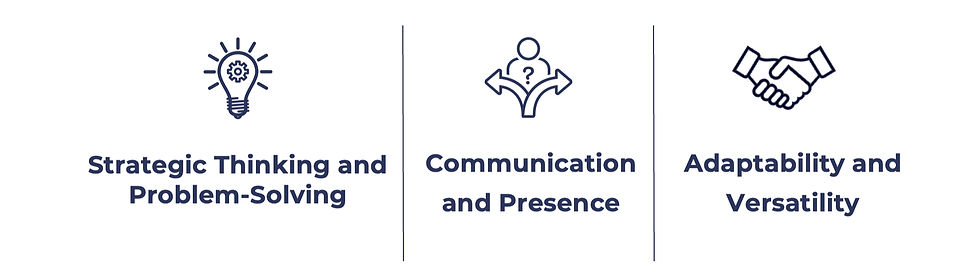
Instead, they're assessing three critical dimensions that predict your success as a consultant:
Strategic thinking and problem-solving ability
Communication skills and executive presence
Adaptability and versatility under pressure
How McKinsey, BCG, and Bain Score Your Case Interview
Let's break down each one and, more importantly, understand what they really mean in practice.
Dimension 1: Strategic Thinking and Problem-Solving (The Art of Knowing When NOT to Use Frameworks)
Here's where most candidates get it wrong.
They think strategic thinking means pulling out the perfect framework at the perfect time. They believe that if they can just match the case to the right structure (profitability, market entry, M&A), they'll ace this dimension.
But that's not strategic thinking. That's pattern matching.
What Strategic Thinking Actually Looks Like
Real strategic thinking is about understanding the unique context of the problem and adapting your approach accordingly. It's about asking yourself: "What makes THIS situation different?"
The best candidates I've coached demonstrate strategic thinking by:
Pausing before structuring. Instead of immediately launching into a framework, they take 15-20 seconds to absorb the case details. They're not stalling; they're thinking.
Asking clarifying questions that matter. Not generic questions like "What industry is this?" but targeted ones like "Is this a family-owned business or PE-backed?" or "Are we optimizing for growth or cash generation in the next 18 months?"
Adapting their approach mid-case. When new information emerges, they don't force-fit it into their original structure. They acknowledge the shift and adjust.
A Real Example
One candidate I worked with was given a profitability case about a luxury hotel chain. Most candidates would immediately jump into the cost-revenue framework.
Instead, she paused and said: "Before we structure this, can I understand whether the brand positioning is negotiable? Because if we're operating in the ultra-luxury segment, some cost-cutting measures might damage the brand more than they help the bottom line."
That question changed the entire case direction. And that's strategic thinking.
It showed the interviewer she understood that:
Not all cost cuts are equal
Business context matters more than textbook frameworks
Sometimes the "obvious" approach is wrong
The Language That Signals Strategic Thinking
Pay attention to how you phrase things. Strategic thinkers use language like:
"Given that this is a family-owned business, the typical PE playbook might not work here"
"This assumption changes things, let me reconsider my approach"
"I'm noticing a tension between X and Y. How should we prioritize?"
"Before we go deeper, I want to test whether my initial hypothesis still holds"
Notice what's missing? Rigid framework jargon. Robotic structure announcements. The need to be "right" on the first try.
What Interviewers Are Really Testing
When an interviewer gives you a curveball or challenges your approach, they're not trying to trip you up. They're testing whether you can:
Recognize when your initial approach isn't working
Incorporate new information without getting defensive
Prioritize what matters most (not just what's easiest to analyze)
Think beyond the framework to the actual business problem
The scorecard question isn't "Did they use a framework?" It's "Can they think like a consultant?"
And consultants need to know when to throw the playbook out the window.
Dimension 2: Communication and Presence (The Difference Between Presenting and Advising)
Structured communication is table stakes. If your interviewer can't follow your logic, you're done.
But here's what separates the candidates who get offers from those who don't: executive presence.
Structured Communication vs. Executive Presence
Structured communication means organizing your thoughts logically, signposting your reasoning, and making it easy to follow along. It sounds like:
"I want to break this problem into three areas: revenue drivers, cost structure, and competitive dynamics"
"Let me walk you through my calculation step by step"
"To summarize what we've found so far..."
This is important. But it's not enough.
Executive presence is something different entirely. It's the difference between someone who presents findings and someone who advises. It's what makes a client lean forward and listen.
The Small Shifts That Create Presence
I once coached a candidate who had perfect structure but zero presence. She would say "I think" before every single statement:
"I think we should look at the revenue side first"
"I think the market size is approximately 500 million"
"I think the main issue is customer acquisition costs"
We made one change: replace "I think" with "Based on what we know" or simply state it directly.
"We should look at the revenue side first"
"Based on these assumptions, the market size is approximately 500 million"
"The data suggests the main issue is customer acquisition costs"
Same content. Completely different impact.
Suddenly, she sounded like an advisor, not a student hoping she had the right answer.
What Executive Presence Really Means
Presence in a case interview includes:
Maintaining eye contact (especially when proposing recommendations or responding to pushback). You're not talking to your notebook; you're advising a client.
Acknowledging pushback gracefully. When the interviewer challenges you, don't get defensive. Say things like:
"That's a fair point. Let me reconsider that assumption"
"You're right to push back on that. Here's why I prioritized it, but I'm open to exploring other angles"
Having a point of view. This doesn't mean being stubborn. It means being willing to take a position, defend it with reasoning, and change it when better information emerges.
Using confident language patterns without being arrogant:
"This suggests we should..." (not "Maybe we could possibly...")
"The priority here is..." (not "I guess it might be important to...")
"I'd recommend focusing on X because..." (not "What if we maybe looked at X?")
The Trap Most Candidates Fall Into
Many candidates think they need to be "nice" or "humble" in interviews. So they hedge every statement, apologize for their thinking, and constantly seek validation.
But that's not how advisors speak to clients.
Clients don't hire consultants to say "I think maybe we could possibly consider looking at pricing, but I don't know, what do you think?"
They hire consultants to say "Based on the competitive dynamics and our margin analysis, I recommend we restructure pricing in the mid-market segment. Here's why."
You can be respectful AND authoritative. That's presence.
Dimension 3: Adaptability and Versatility (How You Handle the Curveballs)
Here's a guarantee: your case will throw you a curveball.
Your market sizing assumption will be off. The client's real concern will be different from what you initially thought. You'll go down a path only to discover it's a dead end.
The question isn't whether this will happen. The question is: how will you respond?
The Two Types of Candidates
When faced with a curveball, I've seen two types of candidates:
Type 1: The Defenders
They treat obstacles as threats. They double down on their original approach, trying to make the data fit their framework. They get flustered, defensive, or visibly stressed.
When told their assumption is wrong, they say:
"But if we just adjust this number..."
"Yeah but I still think my approach makes sense because..."
"I don't understand why that wouldn't work..."
Type 2: The Adapters
They treat obstacles as interesting problems to solve. They pivot without panicking. They see new information as a chance to refine their thinking, not as evidence they were "wrong."
When told their assumption is wrong, they say:
"That changes things. Let me reconsider my approach"
"Interesting, that wasn't what I expected. What does this tell us?"
"Good catch. If that's the case, then we should probably focus on..."
Guess which type gets the offer?
Why Adaptability Matters So Much
In real consulting work, you'll constantly encounter:
Clients who change their minds about priorities
Data that contradicts your initial hypothesis
Analyses that lead to unexpected conclusions
Stakeholders who push back on recommendations
Your ability to stay composed, think clearly, and adjust course is what makes you valuable.
The case interview simulates this reality. The curveballs aren't mean-spirited tricks. They're deliberate tests of how you operate under uncertainty.
How to Demonstrate Adaptability
The best candidates I've coached do these things:
They stay curious instead of getting defensive. When challenged, they lean in with genuine interest: "Tell me more about why you think that's an issue" or "What am I missing here?"
They acknowledge the change explicitly. Don't try to pretend your approach was always going to account for this new information. Say: "This is new information that shifts my thinking. Here's how..."
They maintain composure. Your tone, pace, and body language should stay steady. No frantic energy, no visible panic, no long pauses filled with anxiety.
They show their thinking process. Walk the interviewer through how you're adjusting: "Okay, so if customer retention is 30% lower than I assumed, that means the lifetime value calculation changes significantly, which would make the acquisition cost relatively higher..."
A Real Example of Adaptability
A candidate I coached was working through a market entry case. He'd built his entire recommendation around entering through acquisition.
Halfway through, the interviewer said: "What if I told you there are no acquisition targets available in this market?"
Bad response: "Well... um... then I guess we'd have to... maybe organic growth? But I still think acquisition makes more sense if we can find one..."
Good response (what he actually said): "That changes the equation significantly. Without acquisition targets, we're looking at a longer timeline and higher upfront investment. Let me think through what that means for our entry strategy. We'd need to reconsider whether this market is even attractive given those constraints, or whether a partnership model might be more feasible than full ownership."
He didn't defend the sinking ship. He recognized the new reality and adjusted his sails.
That's versatility.
The Biggest Misconception Candidates Have
Here's what most candidates believe: "If I just master the frameworks and get fast at math, I'll pass the case interview."
But frameworks are like grammar rules in a language. You need to know them, but knowing them doesn't make you fluent.
What makes you fluent?
Understanding when to break the rules
Reading the context and adapting your approach
Communicating with clarity and confidence
Staying composed when things don't go as planned
The scorecard isn't measuring what you know. It's measuring who you'll become when a client is counting on you.
Will you be the consultant who robotically applies frameworks regardless of context? Or the one who truly understands the client's problem and knows how to solve it?
Will you present findings or provide advice?
Will you panic when challenged or treat it as an opportunity to think deeper?
How to Prepare Differently (Based on What Actually Gets Scored)
Now that you understand what's really being measured, here's how to adjust your preparation:
For Strategic Thinking:
Stop memorizing frameworks. Start understanding business problems. Read case studies, business news, and company analyses. Ask yourself: "What makes this situation unique?"
Practice the pause. Before structuring, take 15-20 seconds to think. Get comfortable with brief silence.
Work on contextual questions. Don't ask "What industry is this?" Ask "What's the competitive intensity?" or "What's driving the client's urgency on this decision?"
For Communication and Presence:
Record yourself. Watch for hedge words ("I think," "maybe," "possibly"), weak openings, and lack of eye contact.
Practice with "client mode" on. Have your practice partner sit across from you (not beside you) and treat them like a client, not a study buddy.
Develop your signature phrases. Find confident, professional language that feels natural to you. Practice using it until it's automatic.
For Adaptability:
Practice cases where assumptions change mid-stream. Have your partner deliberately throw curveballs at the 10-minute mark.
Get comfortable saying "I was wrong." Practice phrases like "That changes my view" or "I need to reconsider this."
Work on composure. When stressed, slow down your speech, maintain eye contact, and take a breath before responding.
The Bottom Line
McKinsey, BCG, and Bain aren't evaluating whether you can recite frameworks or calculate quickly. Those are just the baseline.
They're evaluating whether you can:
Think strategically about unique business problems (not just match patterns)
Communicate with the presence and confidence of an advisor (not a student)
Adapt and stay composed when reality doesn't match your plan (not defend a sinking ship)
This is good news.
Because while some candidates spend hundreds of hours memorizing frameworks and drilling mental math, you can focus on developing the skills that actually matter.
You can practice pausing and asking better questions. You can work on your language patterns and executive presence. You can learn to see curveballs as interesting problems rather than threats.
You can prepare for what's actually being scored.
And when you sit down for your McKinsey, BCG, or Bain case interview, you won't just be ready to solve a case. You'll be ready to demonstrate that you think, communicate, and operate like a consultant.
That's what gets you the offer.
Ready to prepare the right way? At gradnext, we help candidates master not just the mechanics of case interviews, but the strategic thinking, communication presence, and adaptability that MBB firms actually evaluate.
Our approach focuses on developing you as a future consultant, not just coaching you to pass a test.
Because the difference between getting the offer and getting close? It's understanding what's really being measured and preparing accordingly.

Comments